
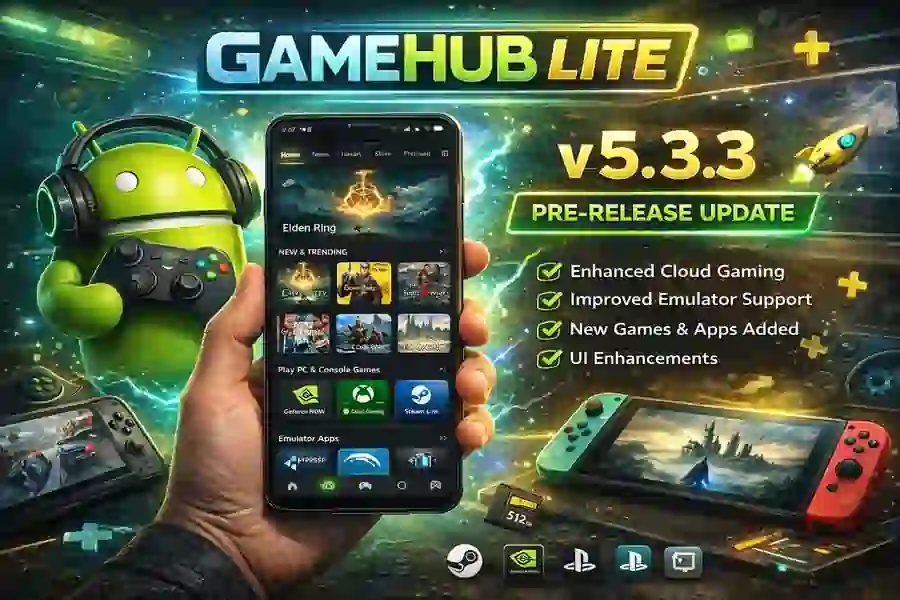
GameHub Lite has released version v5.3.3 as a pre-release update. This version includes RC-1 and RC-2 builds, which are early testing versions before the final release.
These builds are designed for users who want to test new features early. They focus on improving performance, fixing bugs, and adding new capabilities like external storage support.
However, this version is not fully stable. It is mainly for advanced users and testers.
Also Read: GameNative vs GameHub Lite
What Is GameHub Lite v5.3.3 Pre-Release?
The v5.3.3 update is a Release Candidate (RC) build. This means it is close to the final version but still under testing.
There are two versions:
- RC-1 – Initial fixes and basic improvements
- RC-2 – More refined version with better performance
These builds allow users to test new features and report bugs. Developers use this feedback to improve the final version.
GameHub Lite itself is a lightweight emulator that runs PC games on Android. It removes tracking, login requirements, and unnecessary permissions for a smoother experience. For a detailed comparison, check out GameHub vs GameHub Lite to see which one suits your needs.
Also Read: How to Patch GameHub Lite
What’s New in GameHub Lite v5.3.3
This update introduces several important improvements.
1. Micro SD Card Support
The biggest new feature is Micro SD card support for Steam games.
- Store games on SD card
- Run games directly from external storage
- Save internal storage space
This is very useful for users with limited phone storage.
2. Improved Game Import System
Older versions had issues importing games.
Now:
- Game detection is better
- Fewer errors during import
- Smoother setup process
This makes adding PC games much easier.
3. Better Error Logging
GameHub Lite now provides more detailed logs.
- Clear error messages
- Better debugging support
- Faster problem identification
This helps both users and developers fix issues quickly. For a common error, you can also refer to our post on fixing “this feature not supported” in GameHub Lite .
4. Performance Improvements
RC-2 improves overall performance.
- Faster game loading
- Better stability
- Improved file handling
These changes make the emulator more reliable.
Full Changelog (Simple Explanation)
Here is a simplified version of the changelog:
- Fixed game import issues
- Added detailed error logs
- Improved compatibility with devices
- Added SD card support
- Optimized storage handling
These updates focus on stability and usability.
Micro SD Card Support Explained
This is the highlight feature of v5.3.3.
Previously, games had to be stored in internal memory. This caused problems for users with limited space.
Now:
- Insert SD card
- GameHub Lite detects it
- Games can run directly from the card
Supported formats:
- FAT32
- exFAT
NTFS may not work properly.
This feature is still experimental. Slow SD cards may cause lag.
Known Limitations and Warnings
Since this is a pre-release version, it has some risks.
- App may crash sometimes
- Some games may not work
- SD card performance depends on speed
- Not all devices are supported
Developers do not provide full support for this version.
From community feedback:
“This version is meant for testing, not normal users.”
So use it carefully.
Who Should Use This Version?
This version is best for:
- Advanced users
- Emulator testers
- Developers
- Users with SD card setups
Beginners should avoid this version. It requires some technical knowledge.
Tips Before Installing
Before installing v5.3.3:
- Backup your data
- Use a secondary device if possible
- Keep enough storage space
- Do not install over important files
Pre-release versions can cause data issues.
Also Read: How to Install GMS Core / MicroG Services on Android
Conclusion
GameHub Lite v5.3.3 pre-release is a strong update. It introduces useful features like SD card support and improved game importing.
However, it is still experimental and not suitable for everyday users.
If you are an advanced user, this version offers exciting features to test. If you want stability, it is better to wait for the final release.
Overall, this update shows that GameHub Lite is improving fast. It continues to make PC gaming on Android more flexible and powerful.
FAQs
What is GameHub Lite v5.3.3 pre-release?
GameHub Lite v5.3.3 is a test version of the app. It includes RC-1 and RC-2 builds. These versions allow users to try new features before the final release. They are not fully stable and may contain bugs.
Is GameHub Lite v5.3.3 stable for daily use?
No, this version is not fully stable. It is designed for testing purposes. You may face crashes or errors. If you want a smooth experience, use a stable version instead.
What is the biggest feature in this update?
The biggest feature is Micro SD card support. You can now store and run games from an external SD card. This helps save internal storage space.
Can I play Steam games using this version?
Yes, you can play Steam games. GameHub Lite supports Steam integration. However, performance depends on your device and the game you choose.
Why should I use the pre-release version?
You should use it if you want early access to new features. It is useful for advanced users and testers who want to try improvements before the official release.
This is very amazing nice
Good